Brachial Plexus Strategic Map
A premium one-page educational website that turns the uploaded note into a polished, publication-ready anatomy experience with a cinematic hero, elegant cards, and fast clinical recall sections.
Editorial-style anatomy showcase
Use your supplied image as the premium visual hero and the PDF content as the teaching structure.
Roots to branches, no drama, no chaos
The foundational structure follows a strict order that makes localization easier in both exams and clinics.
- Roots: C5–T1 spinal nerve roots
- Trunks: Upper, Middle, Lower
- Divisions: Anterior and Posterior
- Cords: Lateral, Posterior, Medial
- Mnemonic: Real Teachers Don’t Cut Branches
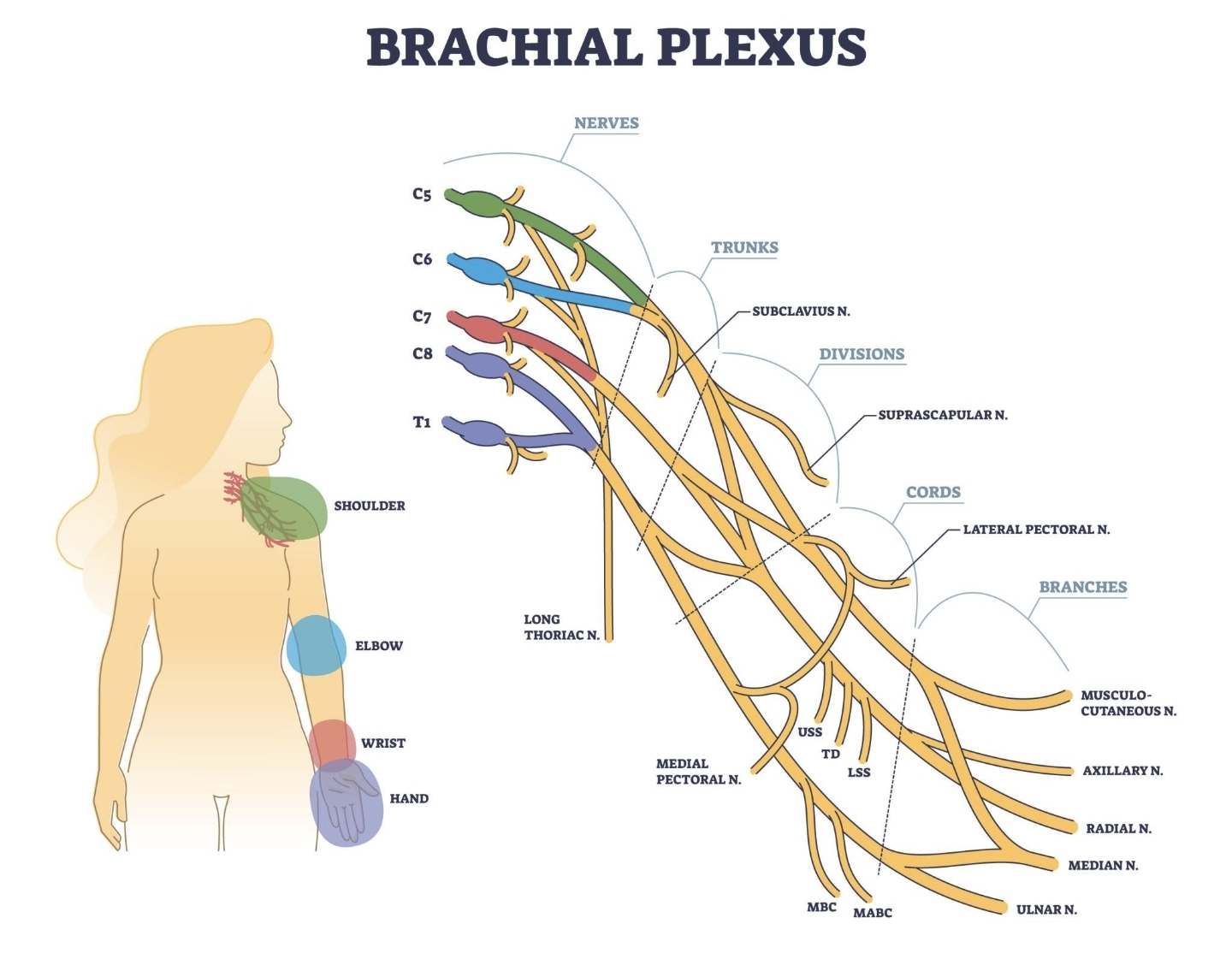
Five terminal nerves. Five territories. Plenty of exam points.
Each major nerve acts like a commander controlling a predictable region of movement and sensation. When it fails, the pattern tells the story.
Axillary
Territory: Shoulder
Motor: Deltoid-driven abduction, teres minor external rotation
Sensory: Regimental badge area of the lateral shoulder
Classic lesion: Surgical neck fracture or anterior shoulder dislocation
Result: Weak abduction + numb lateral shoulder
Musculocutaneous
Territory: Anterior arm
Motor: Elbow flexion and supination
Key muscles: Biceps, brachialis
Sensory: Lateral forearm
Result: Weak flexion + reduced supination
Radial
Territory: Posterior arm and forearm
Motor: Elbow, wrist, and finger extension
Sensory: First dorsal web space
Classic lesion: Mid-shaft humeral fracture
Result: Wrist drop
Median
Territory: Most forearm flexors and lateral hand
Motor: Wrist and finger flexion, thumb opposition
Sensory: Palmar lateral 3½ digits
Common lesion: Carpal tunnel syndrome
Result: Thenar weakness + paresthesia
Ulnar
Territory: Medial hand
Motor: Intrinsic hand muscles, finger abduction/adduction
Sensory: Medial 1½ digits
Classic lesion: Medial epicondyle or cubital tunnel
Result: Clawing + weak finger ab/adduction
Clinical lens
Quick idea: Match injury location + dominant motor loss + sensory badge.
Shoulder: Axillary
Elbow flexion: Musculocutaneous
Wrist drop: Radial
Thumb opposition: Median
Lesion → deficit → territory
| Nerve | Common injury site | Strategic loss |
|---|---|---|
| Axillary | Surgical neck / shoulder dislocation | Loss of shoulder abduction + numb lateral shoulder |
| Musculocutaneous | Arm trauma | Weak elbow flexion + reduced supination + lateral forearm sensory loss |
| Radial | Humeral shaft | Loss of wrist and finger extension → wrist drop |
| Median | Carpal tunnel / forearm injury | Loss of thumb opposition + sensory loss in palmar lateral 3½ digits |
| Ulnar | Medial epicondyle / cubital tunnel | Intrinsic hand weakness → clawing + weak finger ab/adduction |
Strategic outposts before terminal branches
- Dorsal scapular (C5): Rhomboids + levator scapulae
- Long thoracic (C5–7): Serratus anterior → winged scapula if injured
- Suprascapular: Supraspinatus + infraspinatus
- Thoracodorsal: Latissimus dorsi
- Upper / lower subscapular: Subscapularis and teres major support
Mid-arm? Think radial.
Forearm or wrist? Think median or ulnar.
One-glance recall
Built for fast viva review, OSCE stations, and last-minute memory rescue missions.
“I divide the upper limb into nerve territories. Each major nerve acts as a commander controlling predictable motor and sensory function in its region. Injury produces a characteristic pattern of loss within that territory.”
Good illustration